
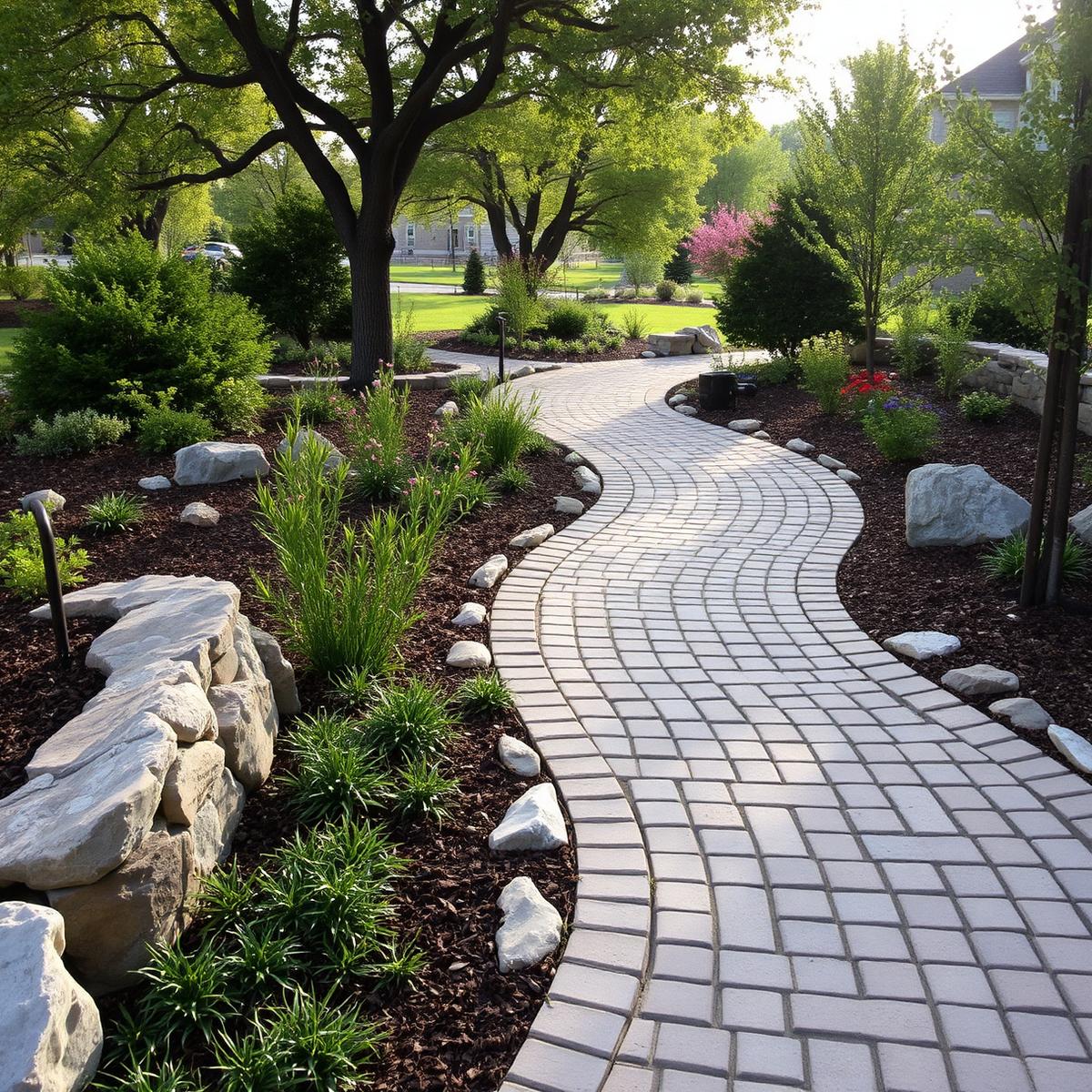
Contractors prevent paver driveway shifting in Fort Worth by engineering a rigid, flexible sub-base system specifically designed to handle North Texas expansive clay soil. In Fort Worth, heavy Blackland clay soil expands significantly when saturated with water during rainy seasons and shrinks intensely during hot, dry summers. Without specialized site preparation, this continuous ground swelling and settling causes poorly built driveways to sink, rut, and shift out of alignment.
At Paverston, we prevent driveway shifting by combining heavy-duty geotextile separation fabric, an extra-deep compacted crushed aggregate base (typically 8 to 12 inches for vehicular traffic), commercial-grade reinforced edge restraints, and polymeric joint sand. This multi-layered system allows the paver surface to flex naturally with seasonal soil expansion while distributing heavy vehicle loads across a stable foundation, keeping your driveway flat and uniform year after year.
What this means for a DFW homeowner
Fort Worth clay is notorious for causing structural damage to traditional poured concrete driveways. Standard poured slabs often crack and tilt because concrete is rigid and cannot adapt when the clay soil beneath it expands or shrinks. Interlocking pavers are inherently superior in this environment because they form a flexible pavement system made of individual units. However, pavers are only as stable as the base beneath them.
For a Fort Worth homeowner, preventing driveway movement means investing in what lies below the surface. If a contractor skips soil stabilization, excavates only 4 inches deep, or fails to install geotextile fabric, native clay soil will pump up into the gravel base during heavy spring storms. Over 2 to 3 years, the gravel mixes with the soft mud, losing its structural strength and leading to deep tire ruts where your vehicles park.
By insisting on proper engineering for North Texas soils, you ensure your driveway withstands daily heavy pickup trucks, delivery vans, and drastic moisture shifts without sagging or developing dangerous tripping hazards.
Best surface or material options for this project
Not all paving materials are rated for driveway vehicular weight in North Texas. Selecting the correct unit thickness and paver type is critical to long-term stability:
- 80mm (3.15-inch) Interlocking Concrete Pavers: This is the industry standard for residential driveways. The extra thickness provides high compressive strength (typically 8,000+ PSI) and interlock capacity needed to support heavy automotive loads.
- Thick Natural Stone Pavers: Dense natural stones like 3-inch thick granite or heavy-grade dimensional limestone can be used for luxury driveways, provided they are rated for vehicular loads.
- Permeable Interlocking Concrete Pavers (PICP): Ideal for properties with strict municipal drainage limits or low-lying areas in Fort Worth. They feature wider joints filled with clean aggregate to allow stormwater to infiltrate quickly while maintaining a stable base.
- Materials to Avoid: Standard 30mm or 50mm (1.18 to 2-inch) patio pavers, thin travertine tiles, or unreinforced flagstone must never be installed on a driveway, as vehicle weight will instantly crack them.
Base prep, drainage, and North Texas soil details
To lock a paver driveway permanently in place over Fort Worth clay, professional installers follow a strict multi-step sub-grade process:
- Deep Excavation: We excavate 12 to 16 inches below finished grade to remove organic topsoil and expose raw sub-grade clay.
- Geotextile Separation Fabric: A heavy, non-woven geotextile stabilization fabric is laid over the raw clay. This membrane acts as a barrier that prevents native mud from migrating upward into the aggregate stone base while allowing ground moisture to drain downward.
- Crushed Aggregate Base: We install 8 to 12 inches of dense-graded crushed concrete or TXDOT Grade 1/2 flex base. The stone is placed in 3-inch lifts and compacted using heavy-duty vibratory plate compactors to reach 98% Standard Proctor Density.
- Bedding Layer: A uniform 1-inch layer of washed concrete sand (ASTM C33) or 1/4-inch angular chip stone (#8 aggregate) is screeded over the base to create a perfectly flat bed for setting the pavers.
- Reinforced Edge Restraints: Edge movement is a primary cause of driveway failure. We secure all exposed borders using troweled concrete bond beams beneath the perimeter pavers or spiked heavy-duty industrial edge restraints anchored directly into the stone base.
- Surface Slope & Drainage: The surface is pitched at a minimum 1.5% to 2% slope (roughly 1/4 inch per foot) away from the home foundation and garage floor to prevent water from pooling near structural walls.
Cost guidance in Dallas–Fort Worth
In the Dallas–Fort Worth metroplex, professional paver driveway installation starts at $20/sq ft, with typical complete driveway projects running between $22 and $38 per square foot installed, depending on paver style, pattern complexity, and site access. Complex laying patterns (like herringbone) add 15% to 25% in labor detail.
If an existing surface must be removed prior to base prep, demolition costs apply: concrete removal adds $6 to $12 per square foot, while existing paver removal adds $4 to $8 per square foot.
| Driveway Scope / Base Package | Cost Per Sq. Ft. (Installed) | Key Base & Stabilization Features Included | | :--- | :--- | :--- | | Standard Interlocking Driveway (80mm) | $22 – $28 | 8" compacted stone base, geotextile fabric, standard edge restraint | | Heavy-Duty / Heavy Load Driveway | $28 – $34 | 10"–12" compacted stone base, heavy geotextile, concrete bond beam | | Premium / Permeable / Complex Pattern | $32 – $38 | Deep crushed open-graded base, specialized border detail, premium pavers | | Concrete Demolition & Removal | + $6 – $12 | Full removal and offsite disposal of old concrete driveway slab | | Existing Paver Removal | + $4 – $8 | Removal and clearing of old, failed paver systems |
What to look for in photos or during a site visit
When evaluating a contractor's previous driveway work or inspecting an active job site, look closely for these technical indicators:
- Garage Lip Flushness: The finished paver surface should sit approximately 1/4 inch above or exactly flush with the garage lip concrete apron to allow smooth entry without tire bump or water trapping.
- Straight Joint Lines: Look down the length of the driveway in project photos. Interlocking joints should form clean, razor-straight lines without wave patterns or drifting curves.
- Excavation Site Cleanliness: During site visits, verify that heavy compaction equipment (such as a 5,000+ lb plate compactor) is on site and that dark gray/black geotextile fabric is visible beneath the gravel aggregate layer.
- Concrete Edge Anchors: Ensure border pavers along lawns and side yards are tightly locked with hidden concrete footings rather than just backfilled topsoil.
Paverston recommendation
Never accept a driveway quote in Fort Worth that cuts corners on base depth or skips geotextile fabric. Methods used in regions with sandy soil simply will not survive North Texas clay. For long-term performance, insistence on an 8 to 12-inch compacted base separated from native clay by a commercial geotextile fabric is mandatory.
At Paverston, every driveway we install is engineered to withstand vehicle weight and ground heave. Ready to upgrade your home with a permanent, rut-free paver driveway? Contact Paverston today at 214-228-1011 or visit /contact to schedule a site consultation with a DFW paver specialist.
Related questions
How deep should the base be for a paver driveway in Fort Worth?
For residential driveways in Fort Worth's expansive clay soil, the aggregate base should be 8 to 12 inches deep after compaction. This is topped with a 1-inch bedding layer, bringing the total excavation depth to 12–16 inches depending on paver thickness.
Can you lay a paver driveway over an existing cracked concrete slab?
Overlaying pavers directly over a cracked concrete driveway in DFW is strongly discouraged. As the expansive clay beneath moves, existing cracks will transfer upward, causing your new pavers to shift and tilt unevenly. Removing the old concrete and installing a proper flexible stone base is the safest choice.
How does polymeric sand prevent driveway pavers from shifting?
Polymeric sand is a blend of graded sand and polymer binders that hardens when activated with water. It locks the pavers together sideways, creating unified interlock across the surface while blocking weed growth, washouts, and insect intrusion.
What happens if a contractor skips geotextile fabric in Fort Worth soil?
Without geotextile fabric, wet clay soil mixes into the crushed gravel base under the weight of driving vehicles. Over time, the stone base sinks into the mud, causing the driveway surface to develop sunken tire ruts and loose perimeter pavers.