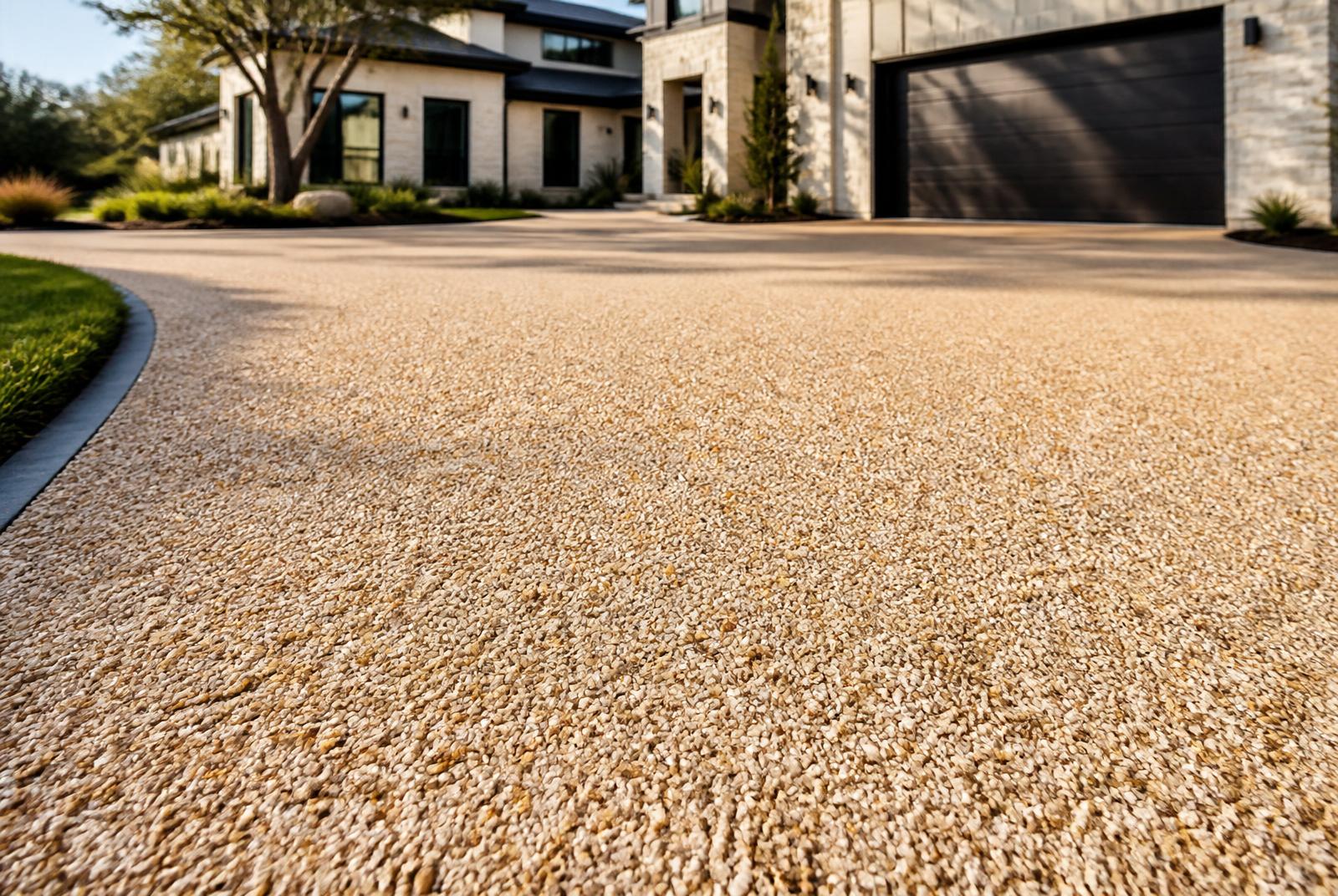
Resin Bound Stone
Seamless. Permeable. Cool underfoot. Built for Texas.
One seamless surface. No joints, no cracks, no puddles.
Resin bound stone is a UV-stable polyurethane resin mixed on-site with kiln-dried natural aggregate and trowel-applied over a prepared base. The finished surface is smooth, seamless, fully permeable, and stays 20–40°F cooler than concrete or asphalt under direct sun — the reason it has taken over premium driveways, patios, and pool surrounds across the DFW metro.
Eight reasons DFW luxury homes are switching from concrete and pavers.
Water drains straight through the surface into the sub-base — no standing water, no puddles, no gutter runoff.
Light aggregate blends measure 20–40°F cooler than concrete or asphalt, safe for bare feet and pets around pools.
One continuous pour, no polymeric sand to wash out, no lines for weeds to grow through.
Aliphatic polyurethane doesn't yellow, chalk, or degrade in direct Texas UV like cheaper aromatic resins.
The natural aggregate face gives an SRV of 65+ wet — safer than tile, wet concrete, or polished stone.
The resin flexes with expansive clay soil movement — no cracking through normal seasonal cycles.
Smooth, level, wheelchair-friendly surface. Ideal for accessible pathways, ramps, and public entries.
Custom aggregate blends from cream to charcoal, warm sandstones to cool grays — matched to your architecture.
Where resin bound stone belongs.
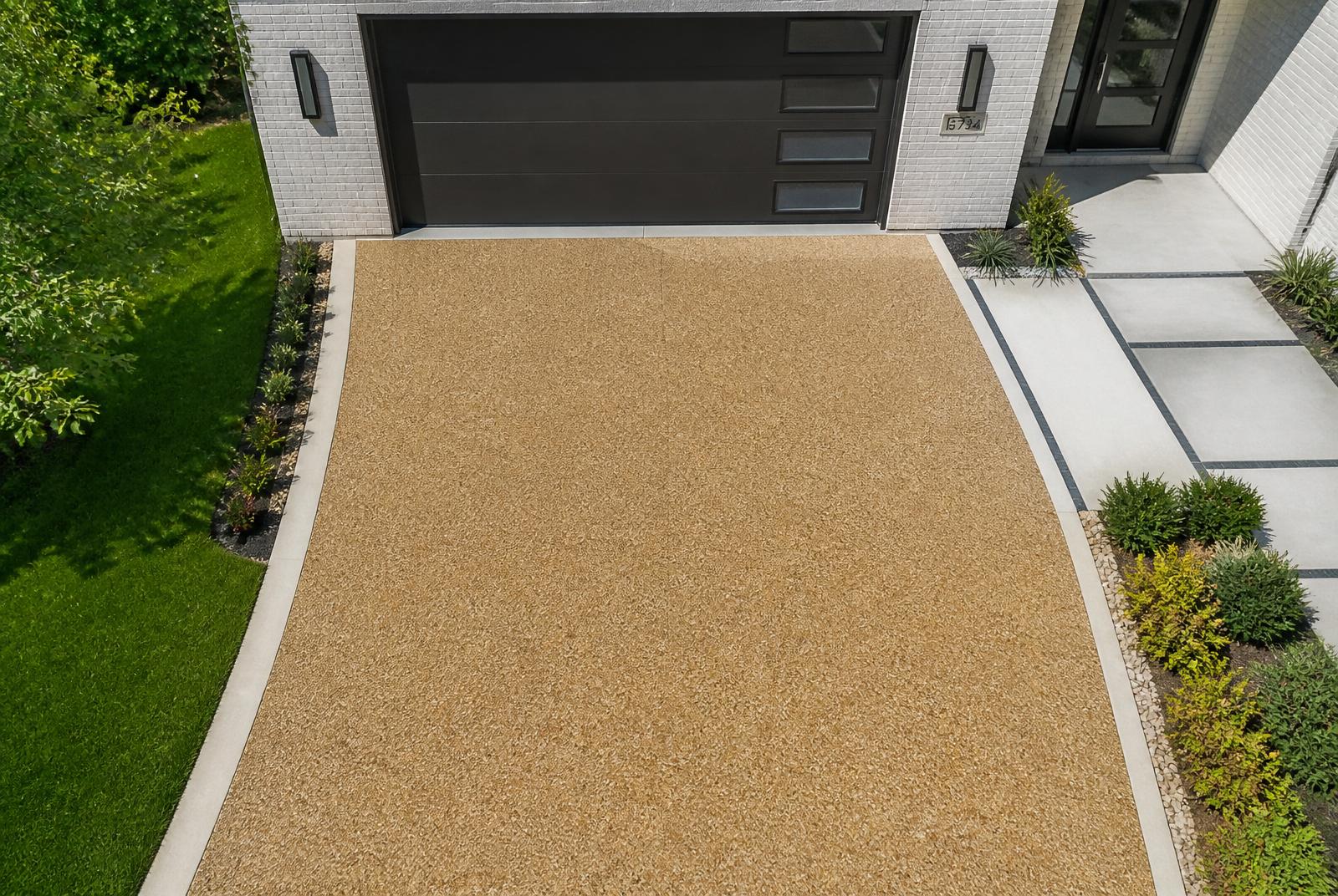
Driveways
Permeable, seamless, up to 40°F cooler than asphalt. Passes most HOA and city permeable-surface codes.
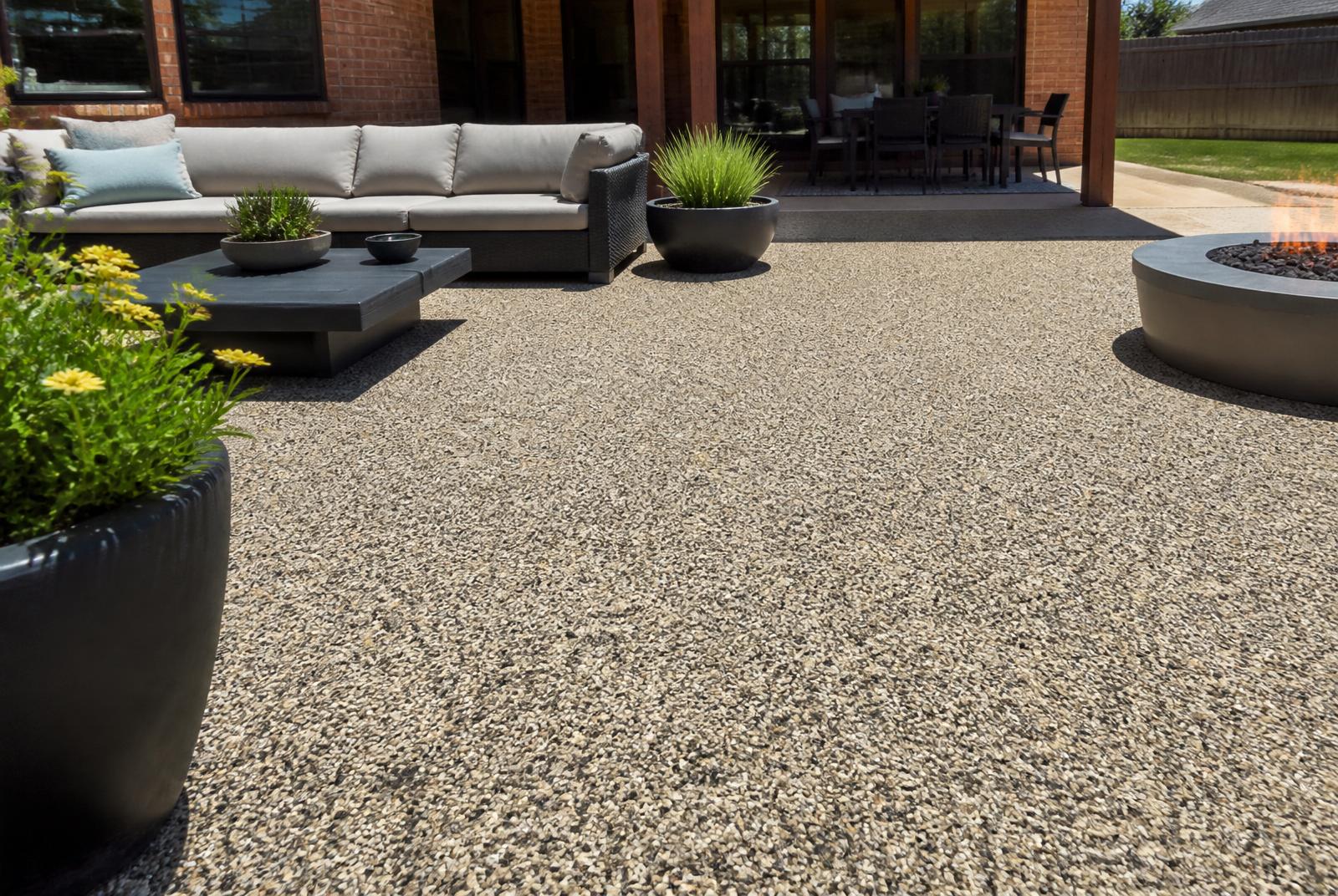
Patios
Joint-free surface — no weeds, no ants, no re-sanding. Cool enough for bare feet in July.
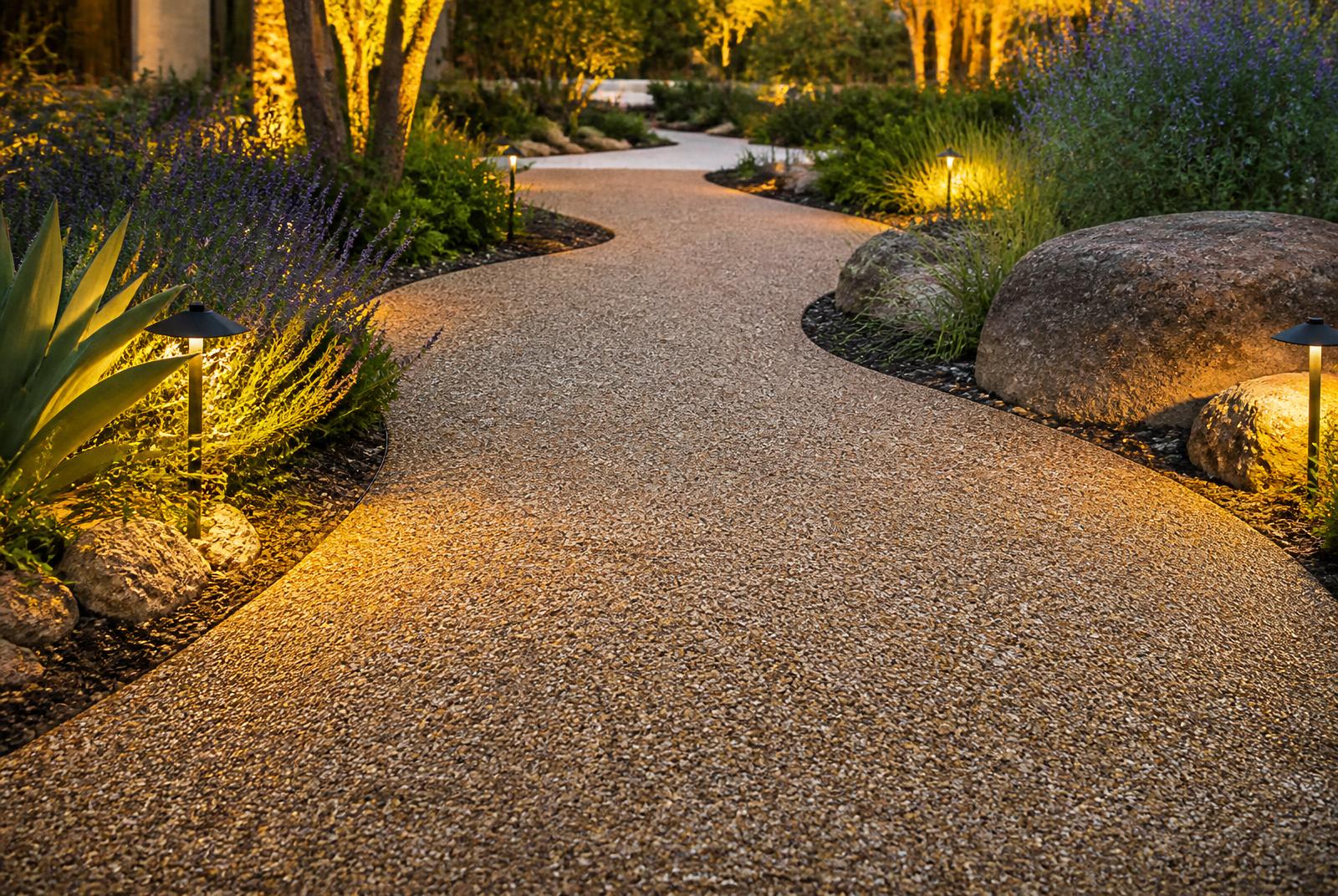
Pool Decks
Slip-resistant when wet, chlorine-safe, doesn't burn feet. Beats travertine and Kool Deck for barefoot comfort.
Walkways
Continuous flowing pathways that curve naturally around planters and architecture. No cut lines or grout.
Commercial Entrances
High-end, low-maintenance surface with SuDS drainage credit and ADA compliance in one system.
HOA Communities
Common area walkways and driveways with predictable color-match repairs and a 10-year warranty.
Luxury Homes
Bespoke aggregate blends, invisible drainage, and a finish that reads bespoke rather than stock.
Accessible Pathways
Fully ADA-compliant — smooth, level, joint-free — for wheelchair, walker, and stroller access.
Decorative Courtyards
Custom logos, borders, inlays, and multi-color patterns cast into a single continuous pour.
Outdoor Living Areas
Fire pit surrounds, outdoor kitchens, bar zones — one seamless surface tying the whole space together.
Aliphatic polyurethane resin + kiln-dried natural aggregate.
Aliphatic polyurethane resin — will not yellow or chalk in direct sun (25-year test data).
Flexes with substrate movement; rated for -30°F to 160°F cycling without cracking.
SRV 65+ wet (BS 7976), BS 8204-6:2008 compliant, safer than tile or wet concrete.
Light blends measure 20–40°F cooler than dark concrete or asphalt on 100°F Texas days.
Fully SuDS-compliant — 3,000+ liters/m²/hour drain-through, eliminates puddles and runoff.
Smooth, joint-free, level surface meets ADA 302 for accessible routes.
Resists engine oil, brake fluid, pool chlorine, salt, and typical driveway/patio contaminants.
Chlorine, salt-water, and pool shock safe — no discoloration or breakdown.
Non-porous resin binder — spills clean up with pressure wash, don't stain the aggregate.
Flexible surface bridges minor root movement without cracking; permeability lets roots keep water access.
No control joints, no concrete cracking; hairline surface issues can be spot-repaired invisibly.
Six-step Paverston install process.
- STEP 01
Site assessment
Walk the site, verify sub-base, measure square footage, and select the aggregate blend from physical samples.
- STEP 02
Sub-base prep
Existing concrete or asphalt (if sound) is cleaned and primed; new sub-base is compacted aggregate with permeable geotextile.
- STEP 03
Edge & drainage
Set aluminum or steel edge restraints and confirm 1–2% fall for surface flow; permeable base handles the rest.
- STEP 04
Resin + aggregate mix
UV-stable polyurethane resin batch-mixed on-site with kiln-dried aggregate in a forced-action mixer.
- STEP 05
Trowel installation
Poured, screeded, and hand-troweled to a uniform 15–18 mm thickness — a single seamless surface, no joints.
- STEP 06
Cure & handoff
Foot traffic in 4–6 hours, vehicles in 24 hours. Full chemical cure at 72 hours.
Resin bound stone vs everything else.
Full head-to-head comparisons — cost, life, heat, drainage, and maintenance.
Resin Bound Stone vs Pavers
Two premium surfaces, two very different install philosophies.
Resin Bound Stone vs Concrete
Concrete is cheaper. Resin is better. Here's the full trade-off.
Resin Bound Stone vs Stamped Concrete
Stamped concrete looks great year one. Resin still looks great year fifteen.
Resin Bound Stone vs Asphalt
Asphalt is cheap. Asphalt is hot. Asphalt looks like a road.
Resin bound stone installations across the metroplex.
Frisco
Frisco's newer luxury builds and HOA density make resin bound the go-to for driveways that need to bypass impervious-cover caps.
Plano
Plano's mix of established homes and remodel activity is a strong fit for over-concrete resin driveway restorations.
McKinney
McKinney's tree-lined lots benefit from resin's permeability — root systems keep access to water instead of buckling slabs.
Southlake
Southlake luxury builds spec resin bound for architect-designed motor courts and pool decks that read bespoke.
Prosper
Prosper's large new-construction lots pair resin driveways with pool decks in the same aggregate blend for cohesion.
Fort Worth
Fort Worth historic districts use resin bound to modernize surfaces without disturbing original hardscape or root systems.
Dallas
Dallas urban infill and Highland Park / Preston Hollow luxury remodels use resin for pool decks and courtyards.
Plus every DFW city — see full service area.
Resin bound stone FAQ.
What is resin bound stone?+
Resin bound stone is a permeable outdoor surfacing system made by mixing UV-stable polyurethane resin with natural kiln-dried aggregate on-site, then hand-troweling it over a prepared base to create a smooth, seamless, fully permeable finish. It's the premium alternative to concrete, asphalt, pavers, and stamped concrete.
How much does resin bound stone cost in Texas?+
Preliminary DFW ranges: driveways $24–$40/sq ft installed, patios $22–$36/sq ft, pool decks $28–$45/sq ft. Aggregate blend, sub-base condition, drainage work, and square footage drive the final price. Small residential projects under 400 sq ft carry a mobilization minimum.
How long does resin bound stone last in Texas?+
20–25 years with proper install and light annual maintenance. Paverston backs installation with a 10-year workmanship warranty; the aliphatic resin itself carries 25-year UV performance data from the manufacturer.
Is resin bound stone better than pavers?+
For seamlessness, permeability, and barefoot comfort — yes. Pavers still win on individual replaceability and lower upfront cost per square foot. Resin is the choice when you want a joint-free, weed-free, cool-surface finish that reads more architectural.
Is resin bound stone better than concrete?+
For appearance, temperature, drainage, and crack resistance — yes. Concrete is cheaper per square foot upfront. Resin bound is 3–5× more expensive but has no control joints, no cracking, drains through, and stays 20–40°F cooler on hot Texas days.
Is resin bound the same as resin bonded?+
No. Resin bound is fully permeable — the aggregate is mixed into the resin and troweled as one system. Resin bonded is a thin decorative layer scattered onto a resin coat over a solid base — not permeable. Paverston installs resin bound only.
Does resin bound stone get hot in the summer?+
Much less than concrete or asphalt. Light aggregate blends (cream, gold, buff) measure 20–40°F cooler than dark concrete under 100°F Texas sun — safe for bare feet around pools.
Is resin bound stone slippery when wet?+
No. The natural aggregate face gives an SRV of 65+ wet — significantly safer than wet tile, wet concrete, or polished stone. Suitable around pools and splash zones without added grit.
Can resin bound stone be installed over existing concrete?+
Yes, when the existing slab is structurally sound and drains properly. This is one of resin's biggest advantages — you can transform a cracked, stained driveway or pool deck without demo and haul-off, saving $6–$12 per square foot.
How is resin bound stone installed?+
Sub-base prep, edge restraints, on-site mixing of UV resin and aggregate in a forced-action mixer, screed and hand-trowel to 15–18 mm thickness, cure. Foot traffic in 4–6 hours, cars in 24 hours.
How thick is a resin bound stone driveway?+
18 mm (about 3/4 inch) for driveways carrying full-size vehicles. Patios, pool decks, and walkways install at 15 mm.
Does resin bound stone drain?+
Yes — fully. Water passes through at 3,000+ liters per square meter per hour into the permeable sub-base. That's the reason many DFW cities and HOAs accept it under impervious-cover restrictions.
Will resin bound stone pass HOA restrictions?+
In most DFW HOAs, yes. Because it's classified as permeable it often bypasses impervious-cover limits that block concrete and asphalt driveway expansions. We provide the technical spec sheet for HOA submissions.
Does it work around swimming pools?+
Yes — it's one of the best pool deck surfaces for Texas. Chlorine-safe, salt-safe, slip-resistant when wet, doesn't burn feet, and drains splash-out water instantly instead of pooling.
Can kids and pets use it?+
Yes. Non-toxic once cured, non-abrasive to bare feet and paws, doesn't hold heat, and has no joints for pets to dig at.
Does resin bound stone crack?+
The resin system flexes with substrate movement, so hairline concrete-style cracking doesn't happen. Damage from severe substrate failure (tree root uplift, sub-base washout) can be spot-repaired invisibly by re-troweling matching aggregate blend into the affected area.
How do you clean resin bound stone?+
Rinse with a garden hose weekly. Pressure wash 1–2× per year on a fan tip at moderate pressure. Oil or grease spills lift with a citrus degreaser and rinse — the resin binder is non-porous, the aggregate face doesn't absorb.
Does it stain from oil or leaves?+
Oil and leaf tannins sit on the surface rather than absorbing. Both wash off completely with pressure washing — a major reason luxury home builders spec resin bound over natural stone or exposed aggregate.
How long before I can walk on it? Drive on it?+
Foot traffic 4–6 hours after install (weather dependent). Passenger vehicles 24 hours. Heavy vehicles / trailers 72 hours.
Does resin bound stone need sealing?+
No — the resin itself is the binder. It doesn't require the periodic sealing that pavers, concrete, or stamped concrete need every 3–5 years.
Is it maintenance-free?+
Very low maintenance. Rinse weekly, pressure wash 1–2× per year, spot-treat oil spills. No re-sanding, no re-sealing, no weed treatment, no joint repair.
What aggregate colors are available?+
50+ natural blends — from cream and buff for a bright driveway, to charcoal and slate for modern architecture, to warm gold and terracotta for southwestern homes. All blends are natural stone, not dyed.
How does it compare to Kool Deck around a pool?+
Resin bound outlasts Kool Deck by 2–3×, doesn't chip or flake, stays cooler, and is far more slip-resistant. Kool Deck is cheaper upfront; resin is the long-term value choice.
How does it compare to stamped concrete?+
Resin doesn't crack at control joints, doesn't fade like colored concrete, stays significantly cooler, and drains. Stamped concrete is cheaper upfront but starts looking dated and cracked inside 5–7 years in Texas.
Can you repair a damaged section?+
Yes — one of resin's biggest advantages. A skilled installer can trowel matching aggregate blend into a damaged patch and the repair is virtually invisible, unlike concrete or asphalt patches.
Do I need a permit in DFW?+
For like-for-like resurfacing (over existing concrete) most DFW cities don't require a permit. New driveway construction, expansion, or ROW approach work does — we pull permits and coordinate inspections.
Is it good for tree-lined driveways?+
Excellent. Permeability lets tree roots keep accessing water instead of forcing them to buckle a solid slab, and the flexible resin bridges minor root movement without cracking.
Does resin bound add value to my home?+
Yes — appraisers value it above concrete or asphalt driveways. In luxury DFW neighborhoods (Highland Park, Southlake, Preston Hollow, Prosper), resin bound surfaces show up on premium listings as a differentiator.
Can you match my home's exterior colors?+
Yes — we blend aggregate colors to complement stone, brick, or stucco. Physical sample panels are shown on-site before install so you approve the exact color under your home's light.
What's the ROI on resin bound stone?+
Beyond appraisal value: no re-sealing costs, no crack repairs, no re-sanding, and a 20+ year lifespan. Compared to a stamped concrete deck that needs re-coating every 4–5 years, total 15-year cost of ownership is often lower.
Ready for a resin bound project?
Physical aggregate samples brought to your site. Detailed written estimate within 48 hours.